3 Best Open Source Alternatives to LaunchDarkly

Updated July 2026

LaunchDarkly is the feature management platform many teams adopt when feature flags stop being a few if statements - it gives product and engineering a shared control plane for targeting, staged rollouts, kill switches, approvals, and experiment data across a large SDK surface. The friction usually shows up when flags become part of the hot path: usage-based billing can make every new environment, service, or client context feel like a cost decision, and the release switch for your own product lives behind someone else's hosted control plane.

Open source alternatives let you run that control plane yourself, keep flag data and evaluation paths inside your network, and still get the core pieces - SDKs, segments, gradual rollouts, audit history, and emergency disables.

Unleash logo

1.Unleash

13.6kAGPL-3.0TypeScript Self-host
Unleash screenshot

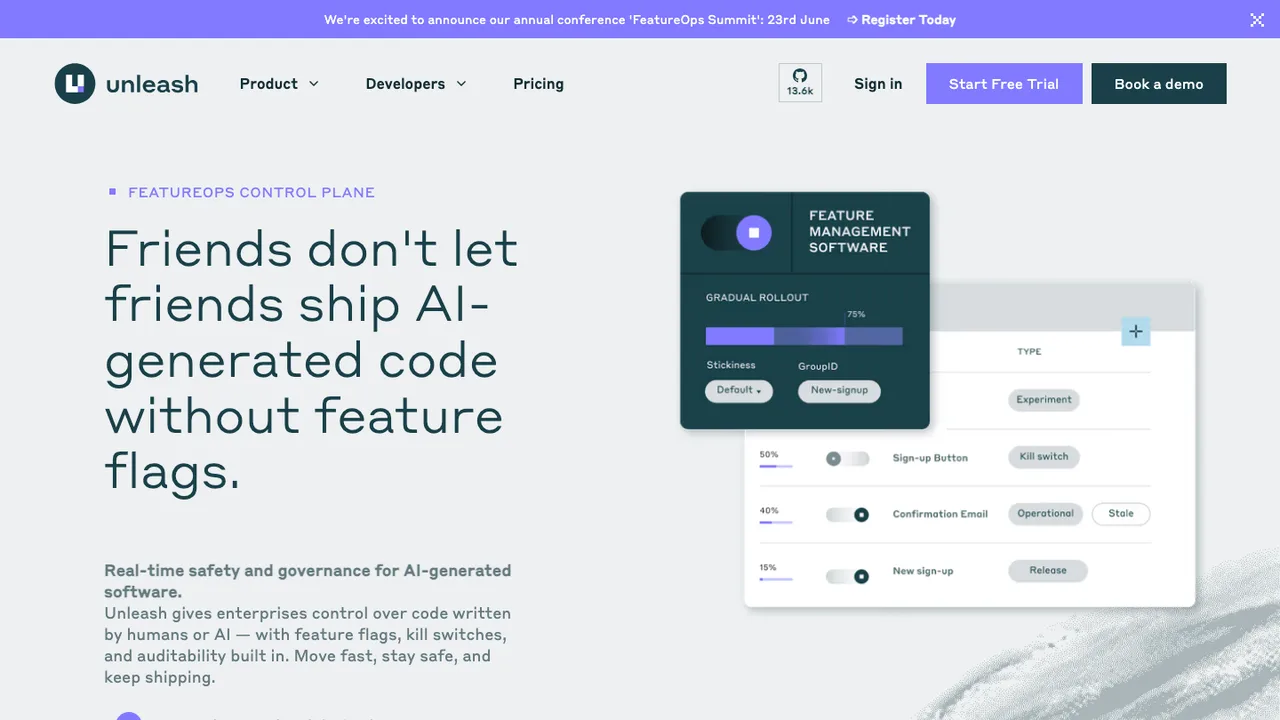
Unleash is an open-source feature management platform for controlling how and when features roll out to users. Feature flags let teams deploy smaller changes, test code with production data, and work on multiple features without separate feature branches.

  • Feature flags across environments, applications, and services
  • Activation strategies for targeted releases and user segments
  • Canary releases, gradual rollouts, kill switches, and A/B testing
  • Audit logs and stale flag insights for technical debt
Flagsmith logo

2.Flagsmith

6.4kBSD-3-ClausePython Self-host
Flagsmith screenshot

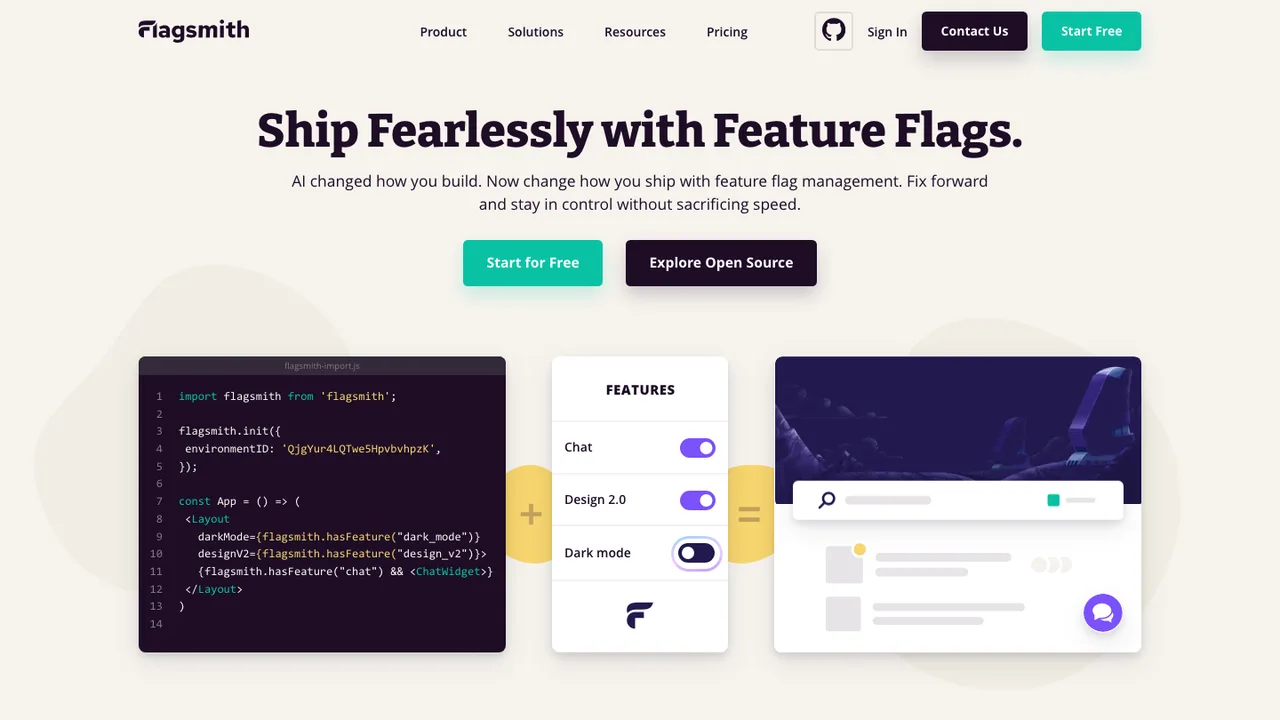
Flagsmith is an open source feature flagging and remote config service. It helps teams create and manage feature flags across web, mobile, and server-side applications, so features can be released behind flags and toggled without deploying new code.

  • Create and manage feature flags across web, mobile, and server-side apps
  • Toggle features remotely without deploying new code
  • Segment users for beta releases, A/B tests, and multivariate tests
  • Manage orgs, projects, roles, and team members
Flipt logo

3.Flipt

4.8kOtherGo Self-host
Flipt screenshot

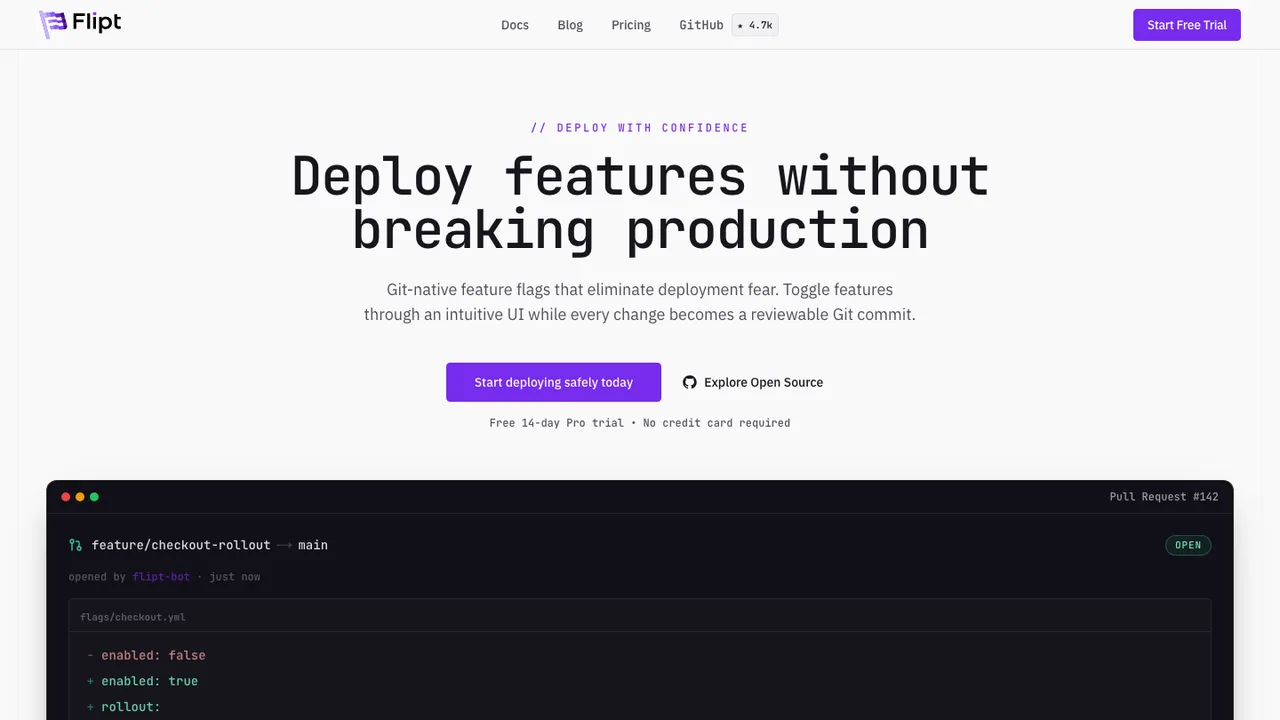
Flipt is a feature management platform for teams that want feature flags to follow their Git workflow. It stores flags in your own Git repositories, so flag changes can be versioned, branched, reviewed, merged, and deployed with the same CI/CD process as application code.

  • Stores feature flags directly in Git repositories
  • Environment mapping by Git branch, directory, or repository
  • Targeting rules, user segments, and percentage rollouts
  • REST and gRPC APIs with OpenFeature support

Switching from LaunchDarkly to open source

Start with the runtime path, not the admin UI. LaunchDarkly is usually embedded deeply through SDK initialization, client keys, server keys, streaming updates, cached flag values, targeting rules, segments, and environment-specific defaults. A replacement has to preserve the failure behavior your code already assumes: what happens on timeout, cold start, network loss, or a missing flag. Also check whether evaluation happens in your app process, through a local relay, at the edge, or by calling a central service on every request. That choice affects latency, blast radius, and how safely you can roll out during an outage.

Expect gaps around workflow and governance before you hit raw flag evaluation limits. LaunchDarkly has mature concepts for projects, environments, flag history, approvals, audit trails, targeting, and SDK coverage. Open source replacements can be strong at deterministic flag serving while still requiring extra work for change reviews, progressive rollout reporting, experimentation analysis, SSO mapping, or compliance evidence. Decide which LaunchDarkly behaviors are product requirements and which are habits. If non-engineers change production flags today, spend real time on permissions, review flow, naming conventions, and rollback drills before the switch.

Migration is mostly inventory, mapping, and verification. Use LaunchDarkly exports or APIs to enumerate projects, environments, flags, variations, defaults, rules, segments, prerequisites, tags, and stale flags. Map those into the new data model, then freeze or tightly control changes while you import. Do not assume event history, experiment results, audit history, or every rule operator will transfer cleanly. Run both systems in parallel for selected services, compare evaluations for known contexts, then rotate SDK keys and configuration by environment. After cutover, remove dead flags from application code instead of carrying a permanent compatibility layer.

Related alternatives

Frequently asked questions

What is the first thing to evaluate when replacing LaunchDarkly?+

Start with where flag evaluation happens and what your application does when it cannot reach the flag service. LaunchDarkly SDKs commonly cache values and keep serving known defaults during network trouble. Your replacement needs the same behavior or an intentional new one. Test startup, timeout, stale cache, missing flag, and invalid context cases before comparing dashboards or workflow features.

How closely can open source tools match LaunchDarkly targeting rules?+

Basic boolean flags, percentage rollouts, environment-specific defaults, and attribute-based targeting are common. The hard part is exact rule semantics: segment nesting, prerequisites, custom attributes, multi-variation flags, fallthrough behavior, and ordering. Export a representative sample of your real flags and compare evaluation results against known user contexts. Small differences can become production incidents when rules control billing, access, or migrations.

Will our existing LaunchDarkly SDK calls keep working?+

Usually not without an adapter or code changes. Some replacements expose similar concepts, but SDK initialization, context objects, variation calls, event flushing, and client-side key handling differ. A thin internal wrapper around flag reads makes migration easier if you already have one. If application code calls LaunchDarkly directly across many services, budget time for mechanical refactoring and regression tests.

How should a team migrate without freezing all feature work?+

Create a short controlled migration window rather than a long complete freeze. First inventory flags and mark owners, criticality, and last-used dates. Import stable flags, then dual-maintain only the flags that are changing during the migration. For high-risk flags, run parallel evaluation and log differences before cutover. This keeps product work moving while preventing silent drift between LaunchDarkly and the replacement.

What data can be exported from LaunchDarkly for migration?+

You can generally extract configuration data through LaunchDarkly APIs or export mechanisms: projects, environments, flags, variations, defaults, targeting rules, segments, tags, and related metadata. Treat that as configuration, not a perfect backup of operational history. The target system may use different names, identifiers, rule operators, and environment structure, so plan for a transformation step rather than a direct import.

Which LaunchDarkly data usually does not survive cleanly?+

Audit history, experimentation results, analytics events, approval context, old evaluation events, and change discussion often do not map cleanly into another system. Even when raw data can be retrieved, the new platform may not understand it. Preserve what you need for compliance as external records, then migrate the current flag state separately. Do not block cutover waiting for historical dashboards to look identical.

Is self-hosting a feature flag service safer than using LaunchDarkly?+

It can be, but only if your operations match the risk. Self-hosting gives you control over network placement, logs, backups, and data retention. It also makes you responsible for uptime, patching, secret handling, and disaster recovery. A feature flag outage can affect every deploy path, so treat the service like critical infrastructure rather than a small internal admin app.

How do costs change after moving off LaunchDarkly?+

The bill usually shifts from subscription spend to engineering and infrastructure cost. You may reduce vendor fees, but you add hosting, monitoring, backups, upgrades, incident response, and migration work. The real comparison is not license price alone. Include the number of services using flags, environments, event volume, compliance requirements, and the cost of rebuilding workflows your teams rely on.

What availability design should replace LaunchDarkly streaming updates?+

Decide whether clients stream flag updates, poll a server, read from a local cache, or evaluate from a replicated data store. For production services, the safest design avoids a remote call on every request and has a defined stale-cache policy. Test regional outages, control-plane downtime, and database failover. A flag platform should degrade predictably, not turn every request into a dependency on an admin service.

Do open source replacements work well for mobile and client-side flags?+

They can, but client-side use has different constraints. Mobile apps need offline defaults, cached values, version skew handling, and careful exposure of public client keys. Browser apps need protection against leaking server-only targeting logic or sensitive flag names. Check SDK support for your actual platforms, not just server languages, and test behavior when users stay on old app versions for months.

What happens to experimentation and metrics when leaving LaunchDarkly?+

Feature flags and experiments are related but not the same system. Some open source replacements can assign variations but do not provide the same statistical analysis, event pipeline, or experiment reporting you may use in LaunchDarkly. If experimentation matters, decide whether the flag system should own metrics or whether assignment will feed your existing analytics stack. Validate exposure events before trusting experiment results.

How should permissions and audit logs be handled after migration?+

Model permissions around who can change production behavior, not around who can see the UI. Separate read access, non-production changes, production toggles, targeting edits, and deletion. Require audit logs that identify the actor, old value, new value, environment, and timestamp. If your current LaunchDarkly process includes approvals, recreate that workflow explicitly rather than assuming repository access or chat approvals are enough.

What integrations matter most when replacing LaunchDarkly?+

Prioritize integrations that affect release safety: CI/CD, incident response, authentication, observability, and change notifications. A flag change should be traceable next to deploys and incidents, and engineers should be able to correlate evaluation changes with errors or latency. If the replacement has an API but no built-in integration, confirm your team is willing to maintain the glue code over time.

How are user segments and attributes migrated out of LaunchDarkly?+

Export segment definitions and the attributes your rules depend on, then verify that the new system uses the same context shape and comparison behavior. Segment membership may be explicit, computed from rules, or derived from application data. Watch for case sensitivity, missing attributes, numeric comparison, array matching, and anonymous users. Replaying sample contexts against both systems is the best way to catch mismatches.

What if the open source project we choose slows down or is abandoned?+

Reduce that risk with an exit plan before adoption. Keep flag definitions exportable, avoid sprinkling vendor-specific SDK calls throughout application code, and document how evaluation works. Prefer a deployment model your team can operate without unusual services. If the project slows down, you should still be able to patch it, fork it temporarily, or migrate again without rewriting every feature gate.