
Cloud-native search engine for logs and traces that searches cloud storage with Elasticsearch-compatible APIs
- Stars11.6k
- Forks593
- Open Issues815
Apache-2.0
- Rust
- HTML
- TypeScript
About Quickwit
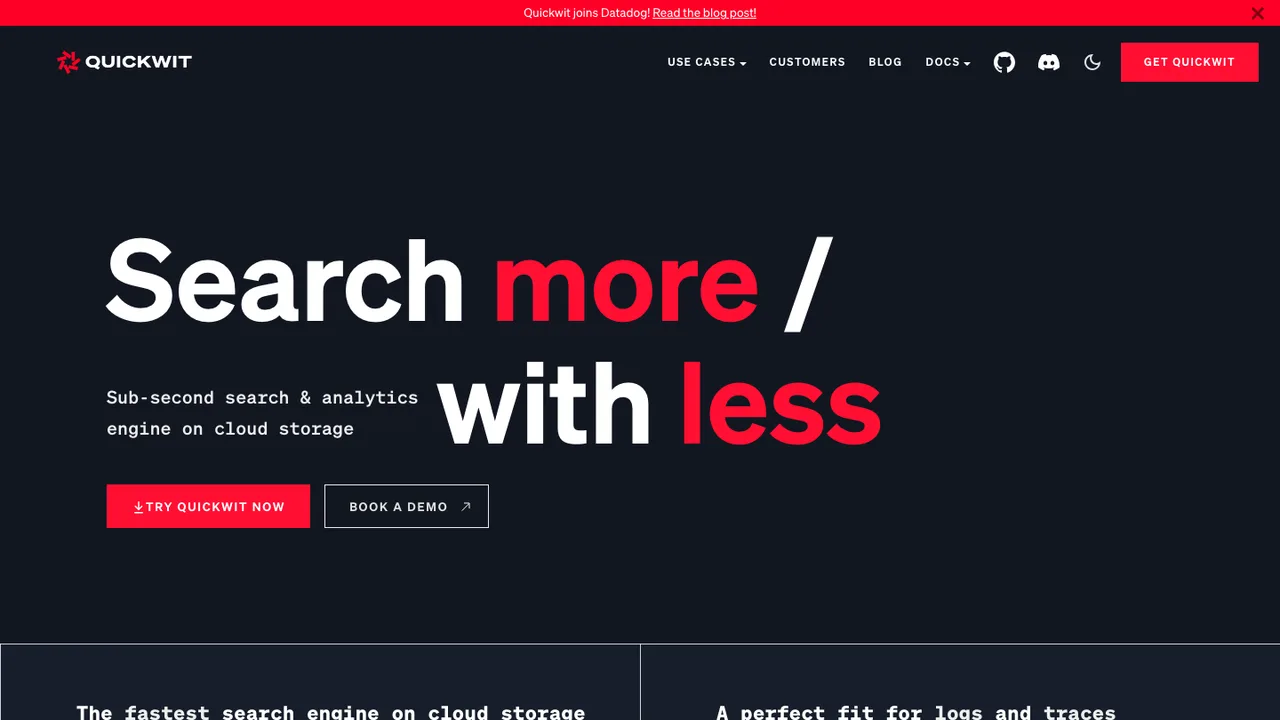
Quickwit is a cloud-native search engine for observability data, focused on logs and distributed traces, with metrics support on the roadmap. It is an open-source alternative to Datadog, Elasticsearch, Loki, and Tempo for teams that need full-text search and analytics over large event data.
It runs sub-second searches on cloud storage such as Amazon S3, Azure Blob Storage, and Google Cloud Storage, with decoupled compute and storage and stateless indexers and searchers. It supports full-text search, aggregation queries, schemaless or strict schema indexing, schemaless analytics, a REST API, and Elasticsearch/OpenSearch-compatible ingest and search APIs.
Quickwit works with Jaeger, OTEL logs and traces, a Grafana data source, and native Kafka, Kinesis, and Pulsar sources. It is Kubernetes ready with a Helm chart, supports multiple indexes, partitioning, retention policies, delete tasks for GDPR use cases, HA search, and HA indexing with Kafka. It is licensed Apache-2.0.
Key features
- Full-text search and aggregation queries
- Elasticsearch/OpenSearch-compatible ingest and search APIs
- OTEL-native logs and traces with Jaeger-native tracing
- Schemaless or strict schema indexing with schemaless analytics
- Decoupled compute and storage on S3, Azure Blob, and GCS
Details
- First released
- 2021
- Storage
- Amazon S3 · Azure Blob · GCS
- API
- REST · Elasticsearch/OpenSearch subset
- Ingest
- Kafka · Kinesis · Pulsar
- Deployment
- Kubernetes ready · Helm chart
- License
- Apache-2.0