
Emulates and virtualizes whole machines, running an OS or binary built for one architecture on another
- Stars13.7k
- Forks7.2k
- Open Issues0

Other
- C
- C++
- Python
About QEMU
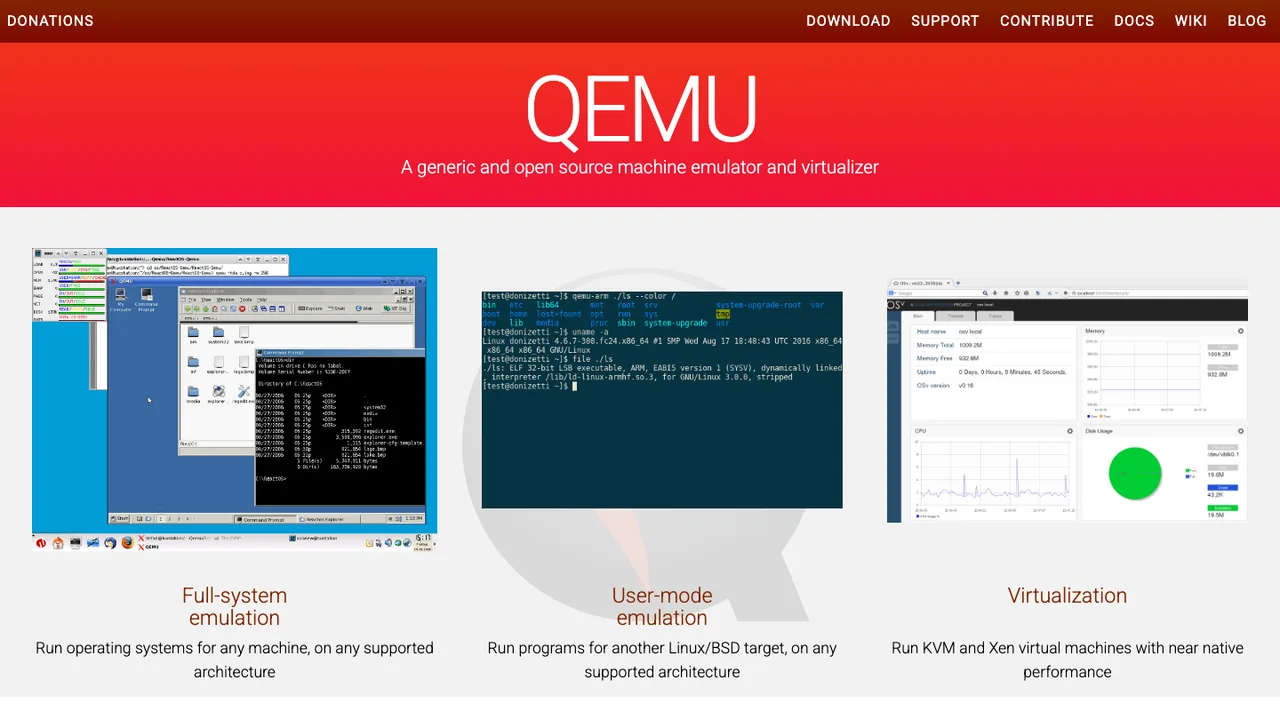
QEMU emulates a complete machine in software, so an operating system or binary built for one CPU architecture runs on a host with a different one. With no hardware virtualization it emulates everything; paired with KVM or Xen it hands the CPU to the hypervisor and runs guests at near-native speed. This is the engine underneath much of the Linux virtualization stack.
It also does userspace emulation for Linux and BSD, running a binary built for one ABI on a host with another. The command line and monitor API are stable, so QEMU is driven directly or through higher-level layers such as libvirt.
QEMU is GPL-2 licensed and builds on Linux, macOS, and Windows via Mingw64, plus other UNIX targets. Source lives in Git, releases ship as tarballs, and changes are submitted as email patches rather than pull requests.
Key features
- Complete machine emulation in software
- Userspace API virtualization for Linux and BSD
- Works with Xen and KVM hypervisors
- Stable command line interface and monitor API
- Runs via libvirt and other management layers
Details
- First released
- 2012
- Platforms
- Windows · macOS · Linux
- Virtualization
- KVM · Xen
- License
- GPL-2
- Source control
- Git
- Deployment
- self-hostable