Google's LVS-based L4 load balancer that runs as a redundant two-node cluster with a floating VIP
- Stars5.7k
- Forks505
- Open Issues16
Apache-2.0
- Go
- Makefile
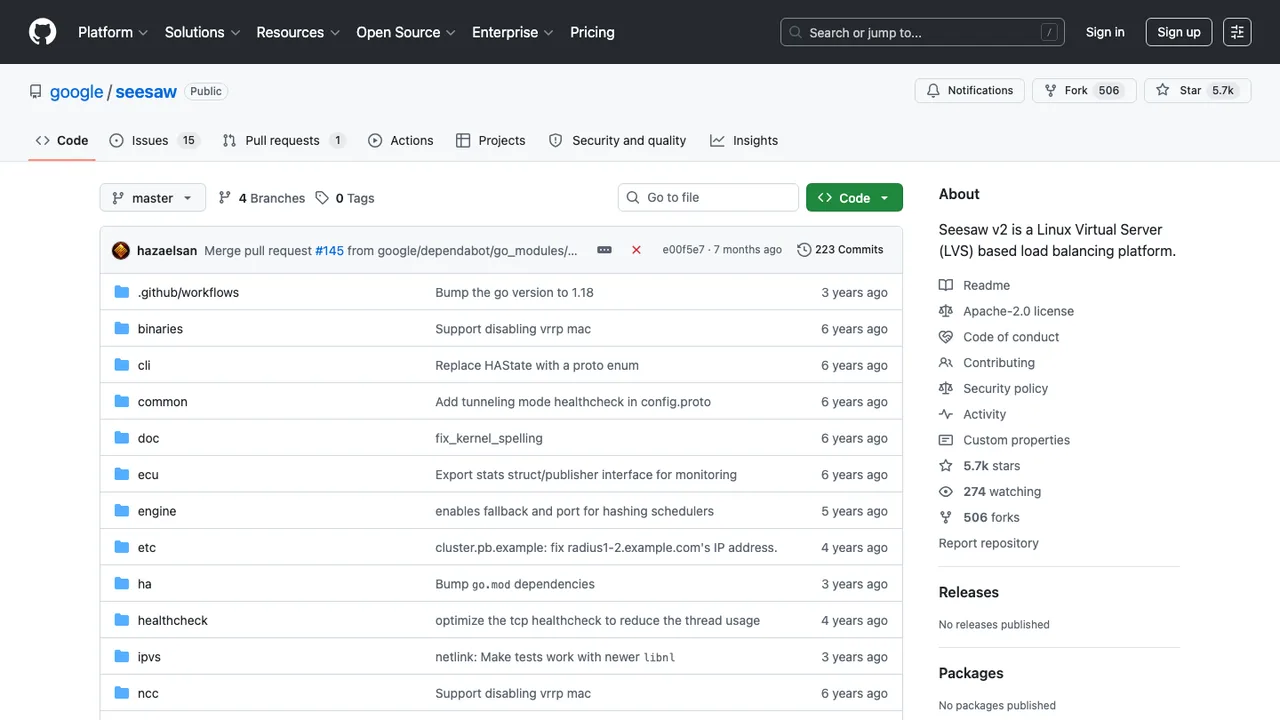
About Seesaw
Seesaw v2 builds a Layer 4 load balancer on top of the Linux Virtual Server kernel facility, but its defining trait is how it stays up. A cluster is two Seesaw nodes sharing a virtual IP; the VIP lives on the current master and slides to the peer if that node goes down, so there is no single point of failure in the balancer itself.
Services are declared centrally as vserver entries, each with its backends and health checks, and the daemon reacts as those checks pass or fail. It supports anycast VIPs advertised and withdrawn over BGP, Direct Server Return, and multiple VLANs. A command-line tool reloads config, triggers failover between nodes, and shows live vserver status.
Written in Go and depending on libnl, Seesaw came out of Google but is not an official Google product. Components run under a watchdog and log to /var/log/seesaw. Self-host on physical or virtual Linux nodes sharing a Layer 2 network. Apache-2.0 licensed.
Key features
- L4 load balancing on Linux Virtual Server
- Two-node cluster with a floating VIP for failover
- Anycast VIPs advertised and withdrawn over BGP
- Direct Server Return and multiple VLAN support
- Central vserver config with per-service health checks
Details
- First released
- 2015
- Platforms
- Linux
- Language
- Go
- Layer
- L4 (LVS)
- Company
- License
- Apache-2.0