
Event-driven web server and reverse proxy that load-balances HTTP and TCP/UDP, and caches content
- Stars31.6k
- Forks8.3k
- Open Issues484

BSD-2-Clause
- C
- Vim Script
- XS
About NGINX
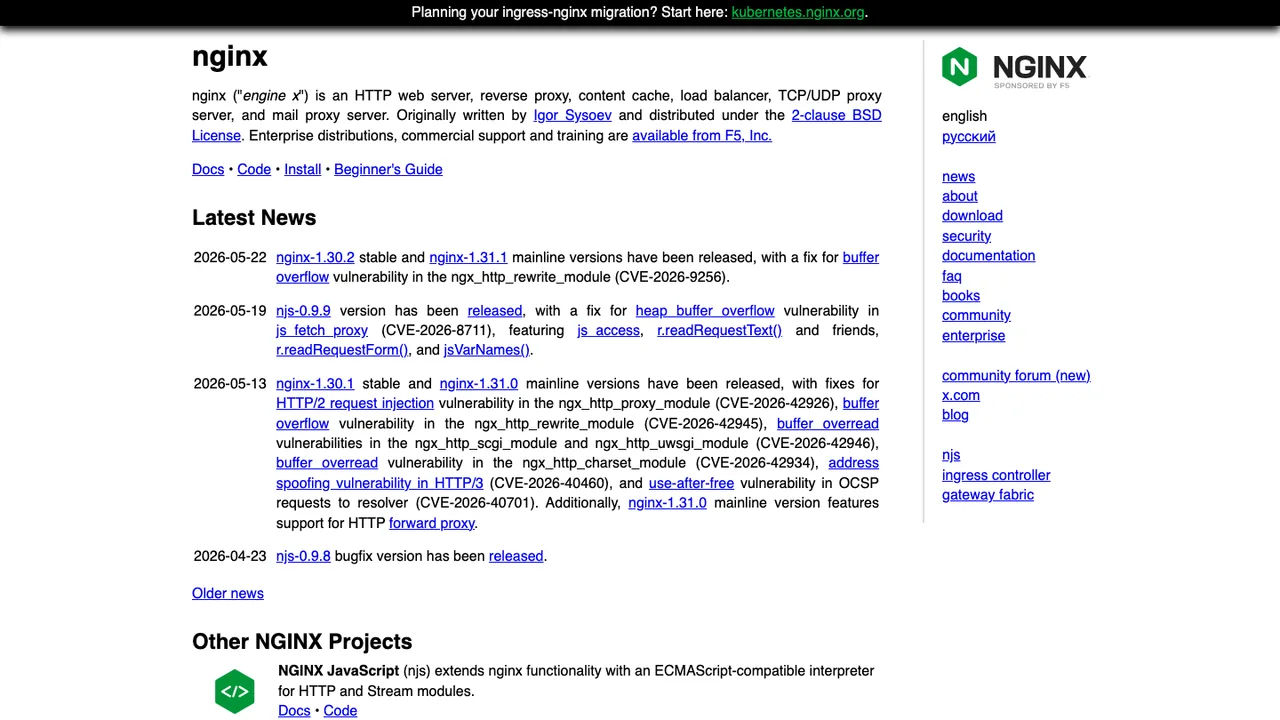
NGINX rose to dominance because its event-driven architecture serves thousands of concurrent connections on modest hardware, where older process-per-request servers fell over. The same engine that serves static files also reverse-proxies to application backends and load-balances across pools, which is why one NGINX instance often fronts an entire stack.
It terminates TLS, speaks HTTP/2, HTTP/3, and QUIC, enforces rate limits, and caches upstream responses to take load off origin services. Beyond HTTP it proxies and balances raw TCP and UDP. Behavior is composed from modules, compiled in statically or loaded dynamically at runtime, so the binary stays lean and you add only what you need.
Written in C, NGINX installs from official binary packages for major Linux distributions and Windows, or builds from source. Developed by F5 (NGINX), which also offers enterprise builds and support. BSD-2-Clause licensed.
Key features
- Web server, reverse proxy, and load balancer in one binary
- HTTP/2, HTTP/3, QUIC, and TLS termination
- TCP and UDP proxying and load balancing
- Content caching and rate limiting
- Static and dynamic modules
Details
- First released
- 2015
- Platforms
- Windows · Linux
- Deployment
- Self-hostable
- Language
- C
- Company
- F5 (NGINX)
- License
- BSD-2-Clause